

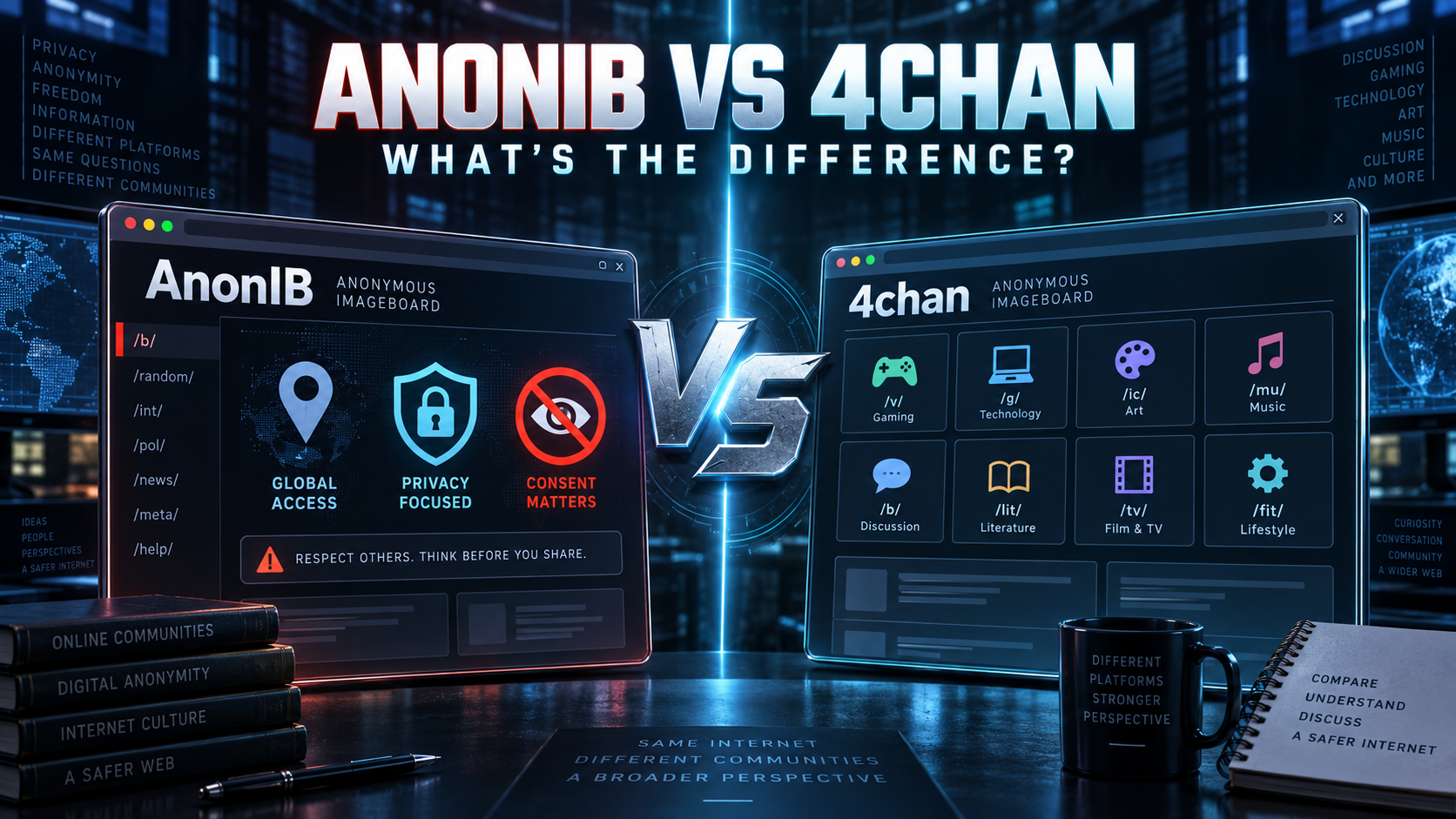
AnonIB and 4chan are often mentioned in the same conversations because both use an anonymous imageboard format. That similarity has led some people to assume that AnonIB was part of 4chan, a 4chan board, or a copy operated by the same organization.
It was not.
AnonIB and 4chan are separate websites with different histories, operators, structures, and reputations. They share certain imageboard features, but they were never simply two names for the same platform.
4chan developed as a broad collection of boards covering subjects such as anime, games, technology, music, photography, fitness, literature, and current events. AnonIB became notorious for location-based requests and the distribution of intimate images—many reportedly posted without the subject’s consent.
Understanding that difference matters, especially for people trying to research AnonIB’s history or remove private content without being directed toward misleading copycats.
AnonIB vs 4chan at a Glance
| Feature | AnonIB | 4chan |
|---|---|---|
| Platform type | Anonymous imageboard | Anonymous imageboard |
| Main reputation | Requests and sharing involving intimate images of identifiable people | Broad discussion platform covering numerous topics |
| Account system | Posts commonly appeared without a permanent public identity | Registration is generally unavailable; users normally post anonymously |
| Board organization | Frequently organized by country, city, school, university, or other location | Primarily organized by subjects such as games, technology, art, music, and anime |
| Doxxing concerns | Identifying information was reportedly posted alongside images | Current published rules prohibit requesting or posting personal information |
| Moderation | Reporting and removal practices varied during its operation | Published global and board-specific rules, moderators, janitors, and post reporting |
| Original site status | Seized by Dutch authorities in 2018 | Active as of September 2026 |
| Relationship | Separate platform | Separate platform |
| Official connection | No verified connection to 4chan | No verified connection to AnonIB |
The shared format is real. The idea that the two services were the same is not.
What Was AnonIB?
AnonIB—generally interpreted as Anonymous Image Board—was a forum where visitors could create threads, upload images, and reply without consistently using a permanent public identity.
It became especially notorious for boards organized around real-world locations and communities. Users could request photographs of women from particular countries, cities, schools, or universities. Personal names and social-media details were sometimes posted alongside the material.
ABC News reported that AnonIB contained location-based boards where users requested and traded images of women. Some of those images had reportedly been copied from social media or distributed without consent. The report on AnonIB’s location-based structure was published shortly after the site’s seizure.
The forum’s problems extended beyond ordinary adult content. Investigators connected parts of its community to:
- Non-consensual intimate imagery
- Unauthorized access to cloud accounts
- Requests for private photographs
- Doxxing and personal-information exposure
- Targeted harassment
- Content potentially involving minors
Dutch authorities seized the original forum in April 2018 during a cybercrime investigation. Current websites reusing the AnonIB name should not automatically be considered official continuations.
Our guide to whether AnonIB is still active explains the original shutdown and the later appearance of copycat sites.
What Is 4chan?
4chan is a separate image-based bulletin board launched in 2003. It was inspired by Japan’s Futaba Channel and initially developed around anime and manga discussion before expanding into many other subjects.
According to its current FAQ, 4chan allows people to post comments and images across boards dedicated to different topics. Users generally do not need to register an account. The official 4chan FAQ describes its basic structure and anonymous posting system.
Its boards cover areas including:
- Anime and manga
- Video games
- Technology
- Music
- Photography
- Literature
- Cooking
- Sports
- Fitness
- Travel
- Television and film
- History
- Current events
- Adult material
The range of subjects is one of the biggest differences between 4chan and AnonIB.
Although 4chan has developed a controversial reputation through parts of its culture and content, describing the entire platform as an AnonIB-style forum would be inaccurate. Many of its boards are built around ordinary interests and require work-safe material.
Why Do People Confuse AnonIB With 4chan?
The confusion comes from several design and cultural similarities.
Both Use Boards and Threads
Instead of creating a personal profile and publishing to a follower feed, users select a board and open a thread.
The first message is commonly called the original post, or OP. Other visitors reply beneath it, sometimes attaching additional images.
Both Emphasize Anonymous Posting
Posts on both platforms often appear under a generic anonymous label rather than a conventional username.
That can make discussions feel detached from permanent online identities. It can also create the false impression that users cannot be identified.
Both Are Image-Centered
Starting a thread usually involves uploading an image. The attached image acts as the visual anchor for the discussion.
This differs from a traditional text forum, where an image is optional and the thread is primarily organized around written conversation.
Both Can Feel Temporary
Imageboard threads often disappear from the main board as newer activity replaces them. That temporary feeling encourages fast, informal posting.
However, a disappearing thread is not necessarily gone forever. Other users can take screenshots, download files, quote posts, or preserve content through third-party archives.
Both Have Been Associated With Controversial Content
The anonymous format can support honest discussion, humor, creativity, and niche communities. It can also lower the social barrier to harassment, offensive posts, privacy abuse, or unlawful behavior.
These similarities explain the comparison, but they do not establish a business, ownership, or operational connection.
The Biggest Difference: Purpose and Scope
The clearest distinction between AnonIB vs 4chan is what their communities were organized to discuss.
4chan is a broad, topic-based imageboard. Its homepage lists boards for interests ranging from photography and transportation to science, business, traditional games, and Japanese culture. It also has separate boards where adult material is permitted.
AnonIB developed a much narrower and more troubling identity. Many of its best-known boards centered on finding or sharing images of real, identifiable people.
The difference was not merely that AnonIB allowed adult material. The central issue was the reported presence of images obtained or distributed without consent.
An ordinary adult-content board assumes that material involves consenting adults and lawful distribution. A thread requesting private photographs of a named student, colleague, former partner, or local person raises entirely different privacy and safety concerns.
Topic Boards vs Location-Based Boards
4chan’s structure is mainly based on interests.
Someone interested in technology visits one board, while someone discussing cooking, games, music, or photography chooses another. Individual boards can develop their own rules and community habits.
AnonIB was widely reported to use geographic organization. Threads and boards could be divided by:
- Country
- State or region
- City
- University
- School
- Local community
That structure made the people depicted easier to identify.
A photograph posted to a general adult board may not reveal where the subject lives. The same photograph placed in a thread named after a university or small town immediately narrows the possibilities.
Adding a name, social-media profile, workplace, or school could turn image sharing into targeted doxxing.
Anonymous Posting Works Differently From True Anonymity
Neither platform should be understood as providing guaranteed anonymity.
On 4chan, leaving the name field blank causes a post to appear under the name “Anonymous.” The platform also supports tripcodes, which allow a poster to use a recognizable code without creating a conventional account.
The official FAQ states that a poster’s IP address is not shown publicly but may be visible to administrators. It also says private information may be provided in response to court orders or appropriate law-enforcement cooperation. 4chan’s privacy explanation makes the distinction between public anonymity and internal records clear.
AnonIB users similarly had no reason to assume they were invisible to investigators. The seizure of a server, examination of devices, account records, messages, payment information, and internet-provider data can all create evidence.
“Anonymous” generally means other ordinary users cannot immediately see your legal name. It does not mean:
- No technical records exist
- Administrators cannot see connection data
- Devices contain no evidence
- Uploaded files contain no identifying clues
- Law enforcement cannot obtain records
- Other users cannot connect repeated usernames or writing styles
Public anonymity and complete untraceability are not the same thing.
How Moderation Differs
4chan currently publishes global rules alongside individual requirements for many boards.
Its global rules prohibit users from posting, requesting, or linking to unlawful material. They also prohibit posting or requesting personal information—described in the rules as “dox”—and organizing raids. The current 4chan rules explain those restrictions.
The site says users can report a post as a rule violation, spam, or illegal material. Reports are reviewed by moderators or janitors who can delete posts and request or issue bans.
That does not mean rule-breaking content never appears. Published rules describe what a service says is permitted, not a guarantee that every post is reviewed before publication.
AnonIB also had administrators and some removal processes during parts of its operation. Nevertheless, its overall reputation was built around content that created severe consent and privacy problems. Its location-based organization and requests for images of particular people made those risks central rather than incidental.
A meaningful comparison should therefore consider both written policies and the behavior a platform’s structure encourages.
Content Permanence and Deleted Threads
4chan is known for ephemeral threads.
The official FAQ explains that threads are pushed through a board’s limited number of pages and eventually pruned. Depending on activity, a post may remain available for only hours or days. It also says expired material cannot be recovered from 4chan’s own servers through its normal user-facing process.
That does not guarantee permanent deletion from the internet.
A third party may have:
- Downloaded the image
- Captured a screenshot
- Quoted the post elsewhere
- Saved the page
- Copied it into a private group
- Uploaded it to an external archive
- Reposted it under a different filename
The same persistence problem affected AnonIB. Shutting down the original forum removed a major source, but images already copied by users could continue appearing elsewhere.
This is why removal work often involves more than one website. Victims may need to report the source, search results, reposts, and future duplicates separately.
Are AnonIB and 4chan Owned by the Same People?
There is no credible evidence that the original AnonIB and 4chan were owned or managed by the same organization.
4chan’s current FAQ identifies Hiroyuki Nishimura as its administrator and credits Christopher “moot” Poole as its founder and administrator from 2003 until 2015.
AnonIB had different operators and infrastructure. Its original server was seized by Dutch authorities in 2018.
Visual similarities such as anonymous names, board abbreviations, thumbnail grids, reply numbers, and fast-moving threads come from the broader imageboard format. Many unrelated communities use comparable software and conventions.
A shared layout does not prove shared ownership.
Was AnonIB a Board on 4chan?
No. AnonIB was not a 4chan board.
4chan boards normally use short labels representing subjects. They exist within 4chan’s own website structure and follow its global rules.
AnonIB operated as a separate forum using its own domains, server infrastructure, board categories, and administration.
People may have discussed AnonIB on 4chan, and material may have been copied between different websites by individual users. That still would not make one platform part of the other.
Cross-posting is not ownership.
Did AnonIB Copy 4chan?
It is more accurate to say that both belong to the wider imageboard tradition.
4chan was itself inspired by Japanese imageboards, particularly Futaba Channel. Over time, numerous websites adopted similar features:
- Anonymous default names
- Image-led threads
- Numbered posts
- Quoted replies
- Board abbreviations
- Limited thread lifespans
- Minimal user profiles
- Simple page layouts
AnonIB used recognizable imageboard conventions, but similarity alone does not prove that it was a direct or authorized copy of 4chan.
Which Platform Is More Dangerous?
There is no reliable universal score for website danger.
Risk depends on the board, thread, content, current operator, advertising systems, external links, and the visitor’s behavior.
AnonIB’s documented history creates a particularly serious concern because of its association with hacked private images, non-consensual distribution, and location-based targeting.
4chan covers a much broader range of subjects, but visitors can still encounter disturbing, misleading, adult, hateful, or unsafe material. Its current rules state that users must be at least 18 and that different boards have different content requirements.
Possible risks on anonymous imageboards include:
- Malicious or deceptive links
- Disturbing material
- Privacy exposure
- Harassment
- Misinformation
- Scams
- Copyright violations
- Non-consensual images
- Content involving minors
- Attempts to gather personal information
Do not download an unknown file, install a special viewer, submit personal information, or reuse an important password on an unfamiliar imageboard.
Is 4chan an AnonIB Alternative?
Calling 4chan an AnonIB alternative oversimplifies both platforms and may encourage unsafe searches.
4chan is a broad discussion imageboard, not an official continuation of AnonIB. Its published rules prohibit doxxing and unlawful content. It should not be treated as a legitimate place to search for private photographs of identifiable people.
Anyone looking for an “alternative” because they want leaked or non-consensual content should stop and consider the consent, legal, and personal harm involved.
Anyone researching AnonIB for historical or safety reasons can use reputable reporting, official removal resources, and victim-support organizations without exploring adult boards or alleged archives.
What If Your Image Appears on 4chan?
Use the platform’s post-reporting feature and classify the report accurately.
Before reporting, preserve only the information reasonably needed:
- The complete page address
- Board and thread name
- Post number
- Date and time
- Visible threats or personal information
- A limited screenshot showing the context
Do not redistribute the intimate image while asking others for help.
Because 4chan threads can disappear quickly, record the relevant post information promptly. If the content involves immediate threats, stalking, your home address, or someone under 18, contact the appropriate law-enforcement or child-safety service.
If the image also appears in search engines, submit a separate search-removal request. Search removal reduces discoverability but does not delete the original post.
Our AnonIB leaks and image-removal guide covers platform reports, Google removal, StopNCII, Take It Down, evidence preservation, and account protection.
What If Your Image Appears on an AnonIB Copycat?
Do not assume that a current page is connected with the seized platform.
Copycats may use the AnonIB name to attract visitors, sell false memberships, harvest passwords, or distribute suspicious downloads. Avoid negotiating with an anonymous operator through personal accounts.
Record the exact address and visible post details. Look for a legitimate abuse process, identify relevant service providers where appropriate, and request removal from search engines.
Read our guide to AnonIB mirrors, archives, and copycat risks before interacting with a supposed revival.
Common Imageboard Terms
Understanding a few terms makes the comparison easier.
Board
A section dedicated to a particular topic, community, or category.
Thread
A conversation started by an original post and followed by replies.
OP
Short for original poster or original post, depending on the context.
Bump
A reply that moves an active thread closer to the top of a board.
Pruning
The automatic removal of older threads as newer ones replace them.
Tripcode
A generated code used to create a recognizable posting identity without a conventional registered account.
Doxxing
Publishing or assembling identifying information about someone, particularly when used to expose, intimidate, or harass them.
Image Dump
A thread containing numerous images, often with limited discussion. The phrase does not establish whether those images were obtained or shared lawfully.
Common Misunderstandings
“All Anonymous Imageboards Are the Same”
Imageboards share technical conventions, but their topics, rules, cultures, operators, and moderation systems can be very different.
“AnonIB Was a Secret Section of 4chan”
It was a separate website with its own infrastructure and administrators.
“4chan Has No Rules”
4chan publishes both global rules and board-specific rules. Whether users always follow those rules is a separate question.
“Anonymous Means Administrators Cannot Identify a User”
A public post may omit a name while the service still receives technical information such as an IP address.
“A Deleted Thread Is Gone Forever”
Other users or third-party services may have saved copies before the thread disappeared.
“An Adult Image Is Automatically Consensual”
The age of the person depicted and their consent to distribution must not be assumed from the place where an image appears.
“If Content Appeared on Both Sites, the Sites Must Be Connected”
Individual users can repost material across unrelated platforms. Duplicate content does not establish common ownership.
Frequently Asked Questions
Is AnonIB the same as 4chan?
No. They are separate imageboards with different histories, structures, operators, and content reputations.
Was AnonIB owned by 4chan?
There is no reliable evidence that 4chan owned or operated AnonIB.
Is AnonIB a 4chan board?
No. AnonIB operated as a separate website rather than a board inside 4chan.
Is 4chan still active?
Yes. The official 4chan website remains active as of September 2026. The original AnonIB forum was seized in 2018.
Does 4chan allow doxxing?
Its current global rules prohibit posting or requesting personal information and organizing raids. Rule violations can still appear before moderators identify or remove them.
Do you need an account to use 4chan?
Traditional registration is generally unavailable. Most users post under the default anonymous label, although optional tripcodes can create a recognizable pseudonymous identity.
Are 4chan posts completely anonymous?
They are usually anonymous to ordinary readers, but the platform states that administrators can access information such as IP addresses. Relevant records may also be disclosed under appropriate legal circumstances.
Can AnonIB images appear on 4chan?
A user may repost material across unrelated websites. If private content appears anywhere without consent, report the specific post rather than assuming the platforms are officially connected.
Are AnonIB and 4chan illegal?
A website format is not automatically illegal. Specific actions—such as hacking accounts, distributing intimate images without consent, threatening victims, or possessing child sexual abuse material—can be illegal. Our guide to AnonIB laws and legal risks explains those distinctions.
AnonIB and 4chan share the visual language of anonymous imageboards, but that is where the simple comparison ends. One developed into a broad and influential collection of topic-based boards. The other became infamous for location-based requests and non-consensual intimate content before its server was seized.
Treating the names as interchangeable hides the most important differences: purpose, organization, moderation, consent, and present-day status.

2 Comments
Pingback: How Did AnonIB Work? Anonymous Imageboards, Threads, and Privacy Risks - anonib
Pingback: Is AnonIB Illegal? Laws, Risks, and Consequences - anonib